


| City/Town: • Jacksonville |
| Location Class: • Educational |
| Built: • 1926 | Abandoned: • 2008 |
| Status: • For Sale |
| Photojournalist: • David Bulit |
The Norwood Neighborhood and Its Namesake
The Norwood Elementary School was established in the 1920s and served as a pillar of the community for over 80 years. The history of the Norwood neighborhood is uniquely intertwined with Jacksonville’s medical past, mirroring the legacy of the school’s namesake, Dr. John Kirk Norwood.
Norwood was the son of Dr. Eugene Kirk Norwood, who owned a drug store on the northeast corner of Jefferson and West Union Streets in the historic Black neighborhood of LaVilla. He died when John was just twelve years old. Following in his father’s footsteps, J. K. Norwood would go on to receive his medical degree from Vanderbilt Medical College in 1916.
He served as a Captain in the U.S. Army Medical Corps during World War I, a daunting task where doctors faced unprecedented challenges, including trench warfare injuries, poison gas, and the 1918 influenza pandemic. After leaving the service, Norwood began his own practice in Jacksonville before serving as the city physician and later at St. Luke’s and St. Vincent’s Hospitals.
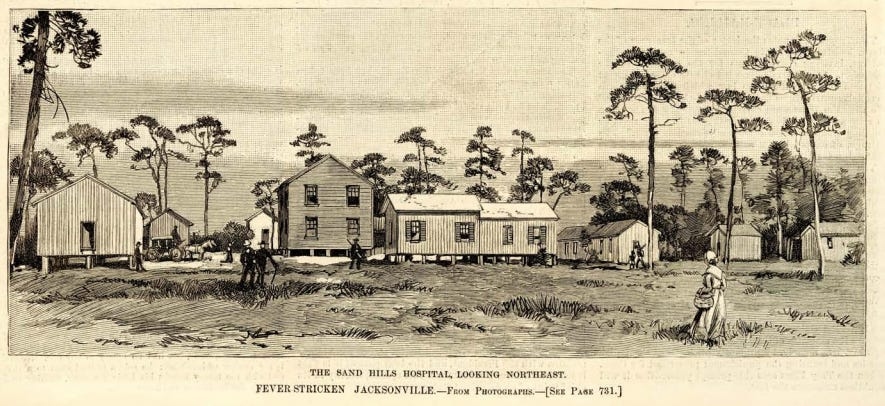
Sand Hills Hospital
During the summer of 1888, a devastating yellow fever outbreak paralyzed Jacksonville, claiming 427 lives and crippling the local economy. Long before the Norwood neighborhood was platted, the area became home to Sand Hills Hospital—a “pest house” believed to have been built around 1883 for smallpox patients and later expanded for yellow fever victims.
The epidemic’s index case was Richard D. McCormick, a Tampa saloonkeeper who broke quarantine and arrived by train, checking into the Grand Union Hotel. Reported by Dr. Neall Mitchell, McCormick was diagnosed on June 29, 1888, and promptly sent to Sand Hills, where his brother, Dr. Sollace Mitchell, served as resident physician. As panic spread rapidly, newspapers like The New York Times declared it “every one for himself,” while residents burned pine, sulfur, and tar in the streets, torched buildings where the sick had died, and fired guns into the air, hoping to purge the “bad air” (miasma) they blamed for the contagion, entirely dismissing Cuban doctor Carlos Finlay’s early mosquito-transmission theory.
While locals viewed Sand Hills Hospital with fear and suspicion, the tireless efforts of its physicians and nurses actually transformed it into a sanctuary in comparison to the quarantine camps on the city outskirts. Proving its efficacy, even Richard McCormick, the epidemic’s index case, survived the outbreak and offered nothing but praise for his stay. Even after the outbreak ended, Sand Hills remained an active part of the city’s healthcare infrastructure, serving as a quarantine site for diseases such as tuberculosis and smallpox.
Norwood Elementary School
Under its first principal, Margaret C. Fairlie, Norwood Elementary began in a humble one-room church in 1925. To make the space work, Fairlie used rolling chalkboards to separate grades and meticulously packed up supplies every few days to make room for church services. By the time the permanent campus opened in April 1926, the community had already rallied to form a PTA and landscape the grounds. The school was named for Dr. John Kirk Norwood, whose family had resided in the area for many years and was the namesake for the community.
The school was born out of necessity when the Community League of Norwood identified that 75 local children were forced to walk to Brentwood Elementary. League members Raymond Harris, Homer Kenyon, and A.C. Haskins successfully petitioned the Duval County School Board and were authorized to select a site. They chose a two-acre parcel on Lem Turner Road, which the board acquired for $9,000. This location was particularly significant because it was next to a municipal artesian well that supplied water to the surrounding community.

Architecture and Construction
Opening for the 1926–27 school year, Norwood Elementary School featured a two-story brick building flanked by single-story wings. The first floor housed classrooms and restrooms, while the second floor contained an auditorium designed to double as two extra classrooms when necessary. Designed by Jacksonville architect Jefferson Davis Powell, the structure showcased a striking variation of the Colonial Revival style, highlighted by divided-light sash windows and an accentuated front entrance featuring a cast-stone broken pediment and arched fanlight. Beyond landscaping the grounds, the local PTA generously outfitted the school with two pianos, two victrolas, a radio, a film projector, blackout shades for the auditorium windows, stage curtains and draperies, and linoleum flooring for the office.
Initial enrollment of 90 students quickly climbed to 270 students and 11 faculty members by 1930. That same year, the school received its first expansion: a $12,500, three-classroom brick wing with an interior connecting corridor added to the rear of the north end. Designed by Jefferson D. Powell and built by the O. P. Woodcock Company, the addition followed a 1927 Duval County Schools study warning that the facility was already short seven rooms and heading toward 400 students by 1930.
To address chronic overcrowding, School Board architect Max L. Worthley designed a detached wooden classroom building in 1941, followed in 1947 by a similar structure housing a cafeteria. Additionally, Jacksonville architect Leeroy Sheftall designed a 1946 single-story brick addition to the rear of the 1930 wing, extending the corridor to accommodate a clinic, a teachers’ restroom, and a boys’ restroom.
Completed in 1951, the school’s final major expansion introduced two classroom wings extending from the front of the original building to form a front courtyard, alongside a new auditorium positioned directly behind the two-story section. Because most of the rear grounds were reserved for recreation and a city-owned lot, the new wings had to project forward, each containing two classrooms and connecting to the main structure via covered walkways.
The auditorium featured a domed roof supported by steel trusses and was linked to the main building by covered steps and a walkway, though its construction required relocating the two earlier wooden structures. Designed by Jacksonville architect John Graveley and built by E. C. Kenyon, these additions concluded the school’s major structural growth.
A notable highlight of Norwood Elementary School was a 12-foot mural depicting Jean Ribault’s 1562 landing at the mouth of the St. Johns River. Featuring palm trees, the Ribault monument, and 42 figures, including Ribault, his men, and Timucuan Indians, the artwork was completed under the Works Progress Administration’s (WPA) Federal Art Project by artist F. A. Angerstein. Born in New York and a Florida resident since 1896, Angerstein studied in Europe, where he spent time with renowned artist John Singer Sargent. Following the school’s closure in 2008, the painting was moved to the LaVilla School of the Arts before eventually undergoing restoration to be permanently displayed on the fourth floor of the Main Library.
Decline and Closure
A 1945 study of Duval County schools revealed that Norwood Elementary accommodated 400 students across six grades in a facility originally built for only 270. To manage the overflow, classes were held in seven standard rooms, four in the detached wooden building, and two makeshift classrooms set up in the auditorium. The school notably lacked a library, clinic, and janitor’s room, while its cafeteria was entirely inadequate. By the 1960s, however, urban decline in the Norwood neighborhood led to a sharp drop in student enrollment.
Even though it operated at half-capacity as the smallest school in the system with just 207 students, Norwood Elementary managed to avoid closure in 1999. Nine years later, students from both Norwood and Lola Culver Elementary Schools were transferred to the new North Shore Elementary School, leaving the surplus Norwood property to be acquired by the Grace and Truth Community Development Corporation, an organization led by Pastor Eugene Johnson of the Grace and Truth Temple of the Living God church.
Purchased by the Grace and Truth Community Development Corp. for $200,000, the complex was slated for a $15 million transformation into the Norwood Business and Development Center. Scheduled for completion in 2012, the project saw the conversion of the former classrooms into affordable housing units and retail space, while turning the 500-seat auditorium into a public venue. Additionally, the facility was to house a senior community center, a pharmacy, and healthcare services dedicated to older residents. Since then, though, the property remains vacant.
Following a foreclosure in 2023, the building has changed ownership multiple times, with the most recent transfer occurring just this past year. It is currently for sale.

Photo Gallery


Leave a reply