

| City/Town: • Fort Myers |
| Location Class: • Commercial |
| Built: • c. 1952 | Abandoned: • 2024 |
| Status: • Demolished |
| Photojournalist: • David Bulit |
History of North Fort Myers’ Shell Factory
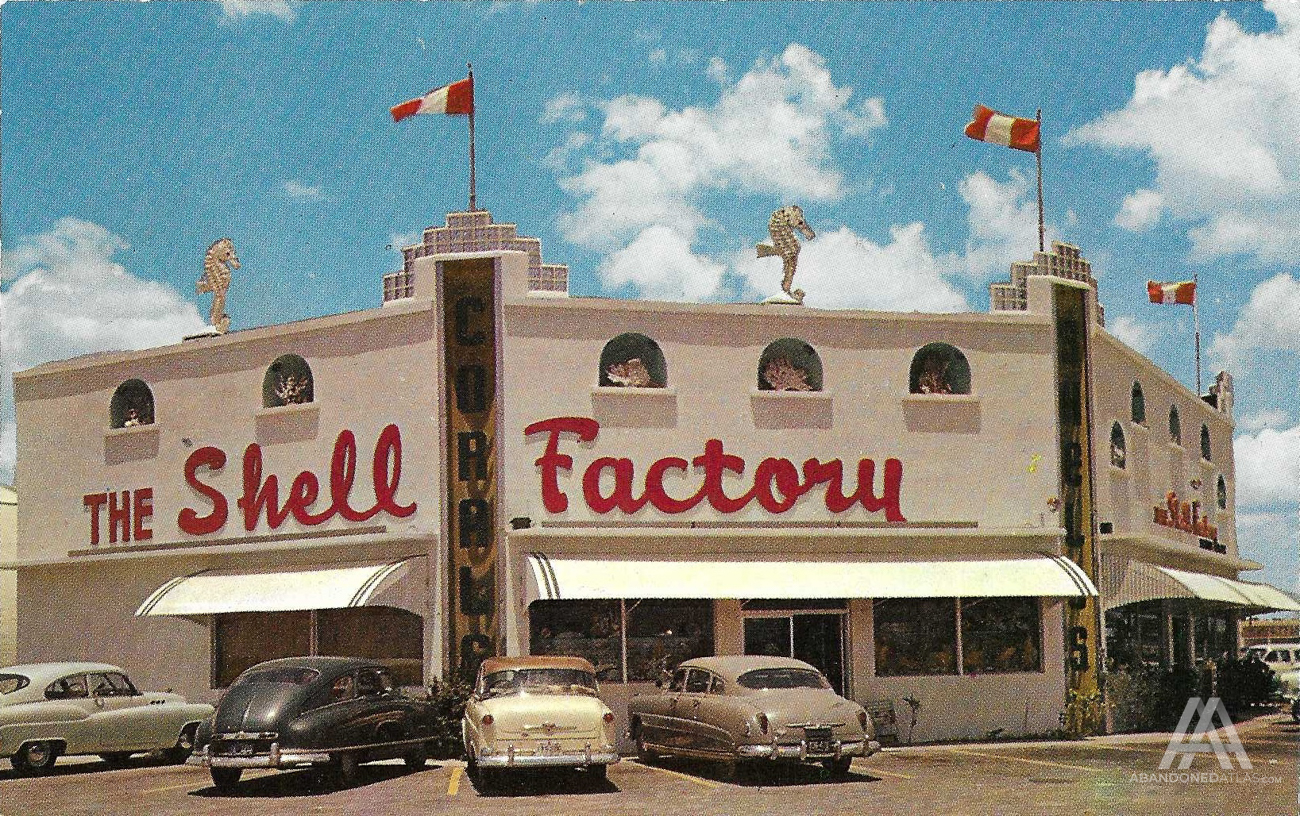
The Shell Factory was an iconic North Fort Myers landmark, with its origins stretching back to the late 1930s in Bonita Springs. It was the heart of a bustling tourism hub that eventually claimed all four corners of its home intersection, cementing its legacy in Southwest Florida’s roadside history.
In 1938, Harold Crant and his wife, Mildred, moved to Bonita Springs from Nova Scotia, Canada, and started what would become one of Bonita Springs’ most popular tourist attractions and largest employers. They bought a small building on the northeast corner of Tamiami Trail and West Terry Street and began selling shells imported from all over the world, including Japan, Africa, and the Philippines. The Crants owned two or three semi-trucks to transport the wholesale items to California and bring back the abalone shells. True to its name, the Shell Factory also sold decorative ornaments and coastal souvenirs created from raw shells.


The Crants’ Other Business Ventures
Distant Drums Seminole Indian Village
Building on the success of their first venture, the Crants expanded across the street with Distant Drums Seminole Village. It borrowed its theme, huts, and props from the movie of the same name, Distant Drums (1951), starring Gary Cooper, which was filmed here in Florida. Even without the airboats of modern Florida, the village mirrored the classic attractions still found today along the old Tamiami Trail near Everglades City. Here, Seminole tribe members lived and worked, entertaining visitors with alligator wrestling shows and immersive glimpses into traditional Seminole life in the Everglades.

The Dome Restaurant
On the other corner, the Crants owned a fruit stand and diner known as the Dome Restaurant, where fresh-squeezed orange juice was served out of a giant orange. Its construction was an oddity, having been built from surplus material from Buckingham Field, the nearby aircraft gunner training base. The base of the restaurant was constructed on wooden .50 caliber ammo crates.
As for the dome itself, it was constructed from two Waller Flexible Gunnery Trainers, created by inventor Fred Waller and the Vitarama Corporation. The Waller Trainer used multiple cameras to project targets onto a domed screen, providing B-17 gunner trainees with a simulated combat environment for aerial target practice. This was one of a few ways aerial gunners were trained during World War II.

Fate of the Dome Restaurant
As for the Dome Restaurant, it was bought by restaurateur Betty Church in 1954 and reopened under the same name. By the late 1980s, the Dome Restaurant had traded its diner roots for a reputation as a gritty dive bar. In an interview with Bev LaLonde of the Historical Society of Bonita Springs, Jimmy Weeks recalls that the establishment’s rowdy atmosphere earned it the nickname “The Gun and Knife Club.”
Complete with western-style swinging saloon doors, the bar was so notorious that Weeks joked guests might be offered a weapon at the door if they weren’t already carrying one. Saturday nights often spiraled into brawls, which the regulars preferred to settle themselves. Keeping the peace was considered a private matter, and calling the police simply wasn’t the local way. It was demolished in 1992 for the widening of Old US 41.

A New Chapter for the Shell Factory
On New Year’s Eve 1951, the Shell Factory burned to the ground. The Crants decided to leave Bonita behind and rebuild the Shell Factory further north in Fort Myers. The Seminole Village was later sold in the 1960s.
Following the fire and the move to Fort Myers, the Crants would continue to experience misfortune as Hurricane Donna destroyed the retail store in 1960, and in 1981, the warehouse caught fire. The opening of Interstate 75 in 1983 also took a lot of traffic far away from the roadside attraction landmark. Facing bankruptcy and foreclosure, it was in 1997 that the Shell Factory was acquired by Thomas R. Cronin Sr., who revitalized the aging tourist trap into the largest independent gift store under one roof in the United States.
Thomas R. Cronin Sr., businessman and philanthropist
Cronin was one of Fort Myers most prominent businessmen, having started two banks, Colonial National and Southwest Capital, and run Cronin Distributors, a beer distributor. He also revitalized the Beacon Manor Executive Suites nursing home, the Renaissance Executive Center, and the Carrell Corners shopping center. He also helped develop Southwest Florida Regional Hospital.
Beyond his business ventures, Cronin was a cornerstone of the community. He helped found the local United Way, eventually serving as its chairman, and dedicated his time to organizations like the YMCA, the Jaycees, and the Octagon Wildlife Sanctuary. His civic leadership extended to the City of Fort Myers, where he presided over the Planning Board and chaired the Downtown Redevelopment Agency. Over the course of his career, Cronin was honored with 13 civic awards—including ‘Citizen of the Year’ and the NAACP’s ‘Freedom of Brotherhood’ award—and was even named the honorary mayor of North Fort Myers.
At the time of his death in 2018, a friend said that “If there was a P.T. Barnum for Southwest Florida in the 21st Century, it was Tom.”
The Shell Factory and Nature Park
When Cronin bought the Shell Factory in 1997 for $1.6 million, it consisted of a cramped storefront with a sparse animal exhibit, all housed in a building where the air conditioning didn’t work and the roof leaked from lack of upkeep. He knew it wasn’t a good investment, but wanted to bring it back to life for the community.
He added tens of thousands of square feet of retail space, featuring a restaurant and a year-round Christmas shop. The grounds included several free museums, spanning fossil collections, taxidermy, and a Kennedy assassination exhibit. Cronin claimed to have the largest collection of rare shells, sponges, coral, fossils, and other sea life specimens, and one of the largest collections of taxidermied animals in the country.
Additional community features included a revamped Fun Park with a zip line, a Nature Park housing over 450 animals, and a dog park equipped with a specialized diving pool. He also provided free buses for local children to take field trips there. The name was also changed to The Shell Factory and Nature Park to coincide with these additions.
After decades of being a staple of the community, the Shell Factory closed down permanently in 2024 as the buildings required extensive repairs after Hurricanes Irma and Ian. The property was put up for sale and sold earlier in January 2026 for $3.92 million. The old landmark was later demolished in March of that year.
Photo Gallery


Further Reading
Recalling tourist landmarks from old Bonita days. 2018. SWSpotlight News Magazine
Leave a reply