


| City/Town: • Titusville |
| Location Class: • Commercial |
| Built: • 1968 | Abandoned: • 2013 |
| Status: • Demolished |
| Photojournalist: • David Bulit |
History of the Miracle City Mall
In 1961, the launch of the human space program sparked a dramatic transformation in Titusville. Over the course of just a decade, the quiet, sandy town of 6,000 swelled into a bustling city of 31,000—a rapid boom that inspired local planners to name their new retail hub the “Miracle City Mall.”
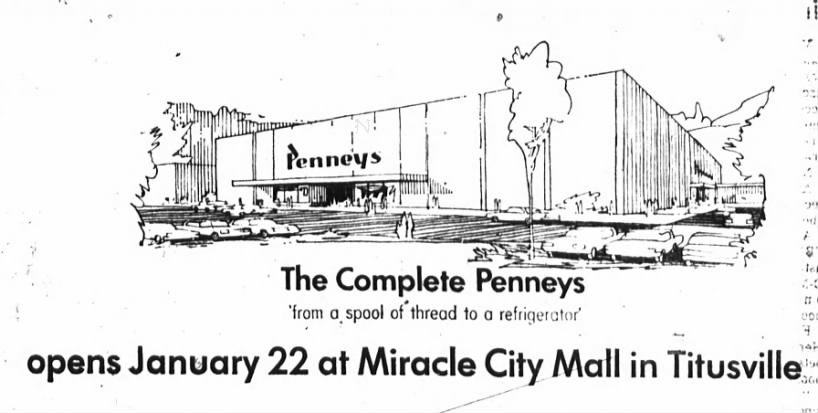
Opening its doors in the 1968 holiday season, the 275,000-square-foot shopping center spanned 32 acres and was anchored by Penneys (later known as JCPenney) and Belk Lindsey (later known simply as Belk’s). The interior concourse featured classic mid-century retailers, including Thom McAn shoes, a McCrory department store, Vogue and Lerner women’s fashions, a Hallmark card shop, Zales Jewelry, and a Walgreens complete with its own snack bar. The mall expanded shortly after with a detached northern building that housed a grocery store and a twin movie theater. The mall’s parking lot provided for more than 1,900 vehicles, along with a full-service 8 bay auto center operated by Penneys.
Among the mall’s original tenants was Bob Socks, a former city councilman who ran an Orange Julius stand for three years before transitioning to manage the Walgreens at the opposite end of the concourse. In 1971, Alden Curfman, who had recently moved his family from North Dakota to operate a Karmelkorn shop in the mall, began leasing the Orange Julius kiosk from Socks and eventually bought the franchise outright. The stand was managed by Curfman’s son, Dave, who later took over the family business. When the franchise agreement with Orange Julius finally expired, the beloved kiosk was rebranded simply as “Dave’s” hot dog stand.

Decline
While opinions vary on the exact catalyst for the mall’s decline, a clear turning point came in 1995 with the arrival of a nearby Walmart Supercenter. By the mid-2000s, Miracle City Mall was a shadow of its former self. Following Belk’s departure, JCPenney stood as the sole remaining anchor, surrounded by only a handful of lingering storefronts. Exacerbated by a broader economic downturn, deferred maintenance soon took its toll, leaving the property in a visible state of decay.
The conclusion of the Space Shuttle program in 2011 dealt a devastating blow to Titusville’s economy and delivered a final, fatal stroke to the struggling mall. Citing health and safety concerns for its employees due to the building’s rapid deterioration, JCPenney vacated the property when its lease expired in February 2013. At that point, JCPenney and Dave’s hot dog stand were the sole surviving tenants; with the anchor’s departure, the mall officially closed its doors.
In 2014, developers stepped in with a $60 million vision to replace the ruins with an open-air retail and entertainment hub called Titus Landing. Wrecking balls arrived in January 2015, erasing the aging Miracle City Mall to build a new community anchor. Hobby Lobby signed on to lead the rebirth in 2016, paving the way for the thriving outdoor plaza that today hosts Bealls, Epic Theaters, and a lively mix of restaurants.
Photo Gallery


Miracle City Mall was flattened recently (2025-2026).